Note: If you are a legacy user of chemistry24 members, please request a new login access to the premium server with your full name and old login email via vip@rapidlearningcenter.com
Want to become a top gun in your class? How about study less yet score high? Sign up this Physics Survival Weekly to learn how. Designed specifically for students who are taking physics, this free newsletter will show you how to survive and excel in class! Weekly topics include:
How to Study Physics Effectively
How to Read Physics Textbooks Easily
How to Solve Physics Problems Systematically
How to Score High on Physics Exams Strategically
How to Master Physics Rapidly
Each week, you will receive study tips on the topics above and visual tutorial or study template to enhance your physics learning. Enter your name and email below to subscribe free:
Magnetic flux:
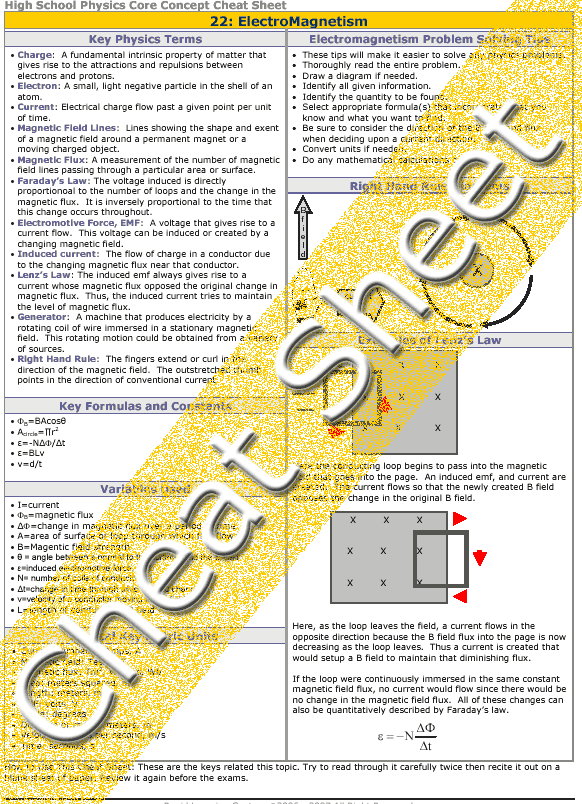
A measurement of the number of magnetic field lines passing through a particular area or surface.
Faraday’s law:
The voltage induced is directly proportionoal to the number of loops and the change in the magnetic flux. It is inversely proportional to the time that this change occurs throughout.
Lenz’s law:
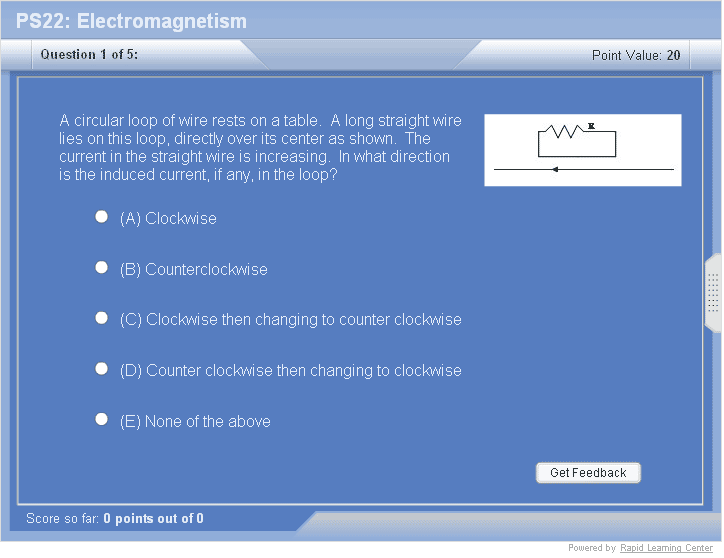
The induced emf always gives rise to a current whose magnetic flux opposed the original change in magnetic flux. Thus, the induced current tries to maintain the level of magnetic flux.
Electromotive force:
A voltage that gives rise to a current flow. This voltage can be induced or created by a changing magnetic field.
Right hand rule, RHR:
The fingers extend or curl in the direction of the magnetic field. The outstretched thumb points in the direction of conventional current.
Generator:
A machine that produces electricity by a rotating coil of wire immersed in a stationary magnetic field. This rotating motion could be obtained from a variety of sources.

Rapid Study Kit for "Title":
Flash Movie
Flash Game
Flash Card
Core Concept Tutorial
Problem Solving Drill
Review Cheat Sheet
"Title" Tutorial Summary :
Magnetic flux describes the number of magnetic field lines passing through a particular area. This idea is similar to rain falling through a hula hoop. Faraday’s law describes the induced electromotive force as the change in flux per amount of time. Lenz’s law describes the direction of that induced current. Again, the right hand rule can be utilized. A conductor moving through a magnetic field can also create an induced electromotive force. These concepts are the basis for an electric generator. Mechanical motion is converted into electric energy.
Tutorial Features:
Specific Tutorial Features:
Animation showing the relationship between magnetic flux and the induced current.
Diagrams and animations showing induced emfs in moving conductors.
Series Features:
Concept map showing inter-connections of new concepts in this tutorial and those previously introduced.
Definition slides introduce terms as they are needed.
Visual representation of concepts
Animated examples—worked out step by step
A concise summary is given at the conclusion of the tutorial.
"Title" Topic List:
Magnetic flux
Formula
Angle
Units
Hoop analogy
Example
Faraday’s law
Formula
Induced electromotive force
Example
Lenz’s law
Right hand rule application
Examples
Electromotive force in a moving conductor
Applications